

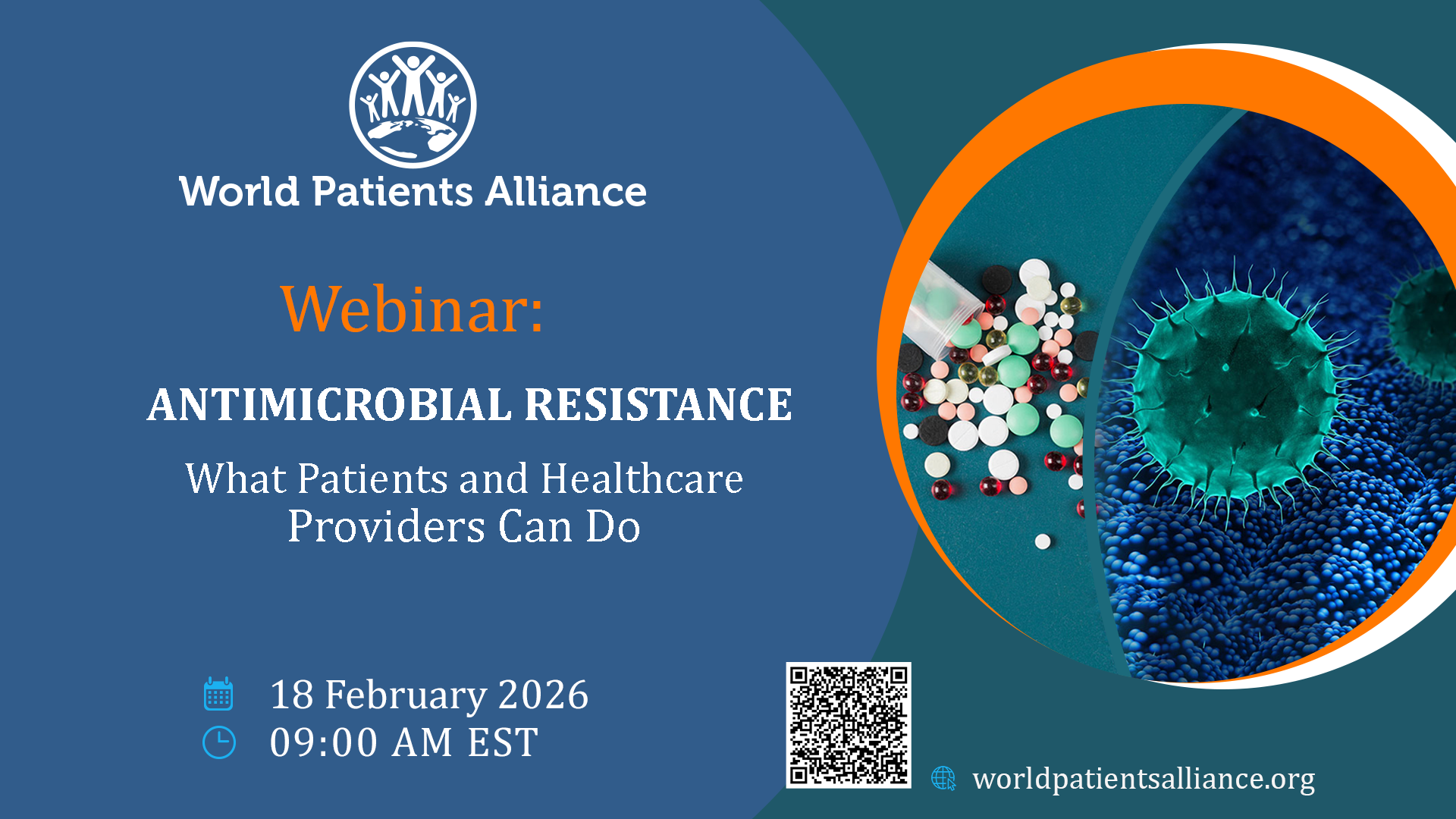
Webinar on Antimicrobial Resistance
Date: December 15, 2025
Organized by: World Patients Alliance (WPA)
Overview
The webinar brought together international experts, patient advocates, and public health leaders to address the mounting global threat of antimicrobial resistance (AMR). The session emphasized AMR as an urgent and immediate challenge impacting patients, healthcare systems, and communities worldwide.
Key Objectives of the Webinar
– Highlight AMR as a major global health threat.
– Emphasize that AMR is already affecting millions and is not a distant issue.
– Share findings from WHO’s GLASS surveillance system.
– Show rising resistance levels among critical pathogens.
– Illustrate the health and economic burden of AMR.
– Position infection prevention as the most effective tool against AMR.
– Promote WASH (Water, Sanitation, Hygiene) in healthcare facilities and communities.
– Reinforce the role of vaccination and hygiene practices
– Position infection prevention as the most effective tool against AMR.
– Promote WASH (Water, Sanitation, Hygiene) in healthcare facilities and communities.
– Reinforce the role of vaccination and hygiene practices.
– Improve health literacy around antibiotics and infections.
– Raise awareness of the dangers of self‑medicating and misusing antibiotics.
– Empower patients to recognize early signs of infection and sepsis.
– Encourage evidence-based prescribing by healthcare providers.
– Support diagnostic testing before treatment decisions.
– Reduce misuse of broad-spectrum or unnecessary antibiotics.
Speakers, Panelists, and Moderators
Welcome and Opening Remarks
Andrew Spiegel | Chair, Board of Directors | WPA
Understanding AMR and Why Patient and Provider Actions Matter
Dr Silvia Bertagnolio, Unit Head, Antimicrobial Resistance Surveillance, WHO
Roles for Patients and Providers in Preventing AMR
Pat Merryweather, Executive Director of Project Patient Care (PPC)
Panel Discussion
Moderator
Helen Haskell, Chair WPA Patient Safety & Quality Council
Panelists:
Regina Kamoga, Executive Director, CHAIN, Uganda
Pat Merryweather, Executive Director of Project Patient Care (PPC)
Silvia Bertagnolio, Unit Head, Antimicrobial Resistance Surveillance, WHO
Candace DeMatteis, Policy Director PARTNERSHIP TO FIGHT CHRONIC DISEASE (PFCD)
Elena Moya, Vice president AEM – Asociación Española Contra la Meningitis
Welcome and Opening Remarks
Andrew Spiegel opened the session by welcoming participants and highlighting the critical importance of addressing antimicrobial resistance (AMR). He emphasized that AMR represents one of the most urgent global health threats, directly affecting patients across all regions and communities. He noted that once-manageable infections are increasingly becoming life-threatening due to resistance to treatment.
He stressed that AMR is not merely a scientific or technical issue but a patient-centered crisis requiring collective global action. He also acknowledged the international audience and encouraged active participation in the discussion.
Key Presentation
Understanding AMR and Why Patient and Provider Actions Matter
Dr. Silvia: Dr. Silvia Bertagnolio presented a concise global overview of antimicrobial resistance (AMR), emphasizing that it is now one of the world’s most urgent health threats. Using WHO’s GLASS surveillance data, she reported that one in six infections is resistant to essential antibiotics, with particularly high resistance in South‑East Asia, Eastern Mediterranean, and Africa. She highlighted alarming trends such as rising resistance in key pathogens like E. coli, Klebsiella pneumoniae, and Acinetobacter, noting increasing resistance even to last‑resort drugs. Dr. Silvia stressed that weak health systems, poor diagnostics, and limited surveillance drive higher resistance, especially in low‑income countries. She concluded by calling for better diagnostics, stronger national surveillance, responsible antibiotic use, and investment in prevention and health system quality to slow the growing AMR crisis.
Roles for Patients and Providers in Preventing AMR
Pat Merryweather: focused on the critical importance of infection prevention—especially through strong WASH (Water, Sanitation, and Hygiene) systems—as the most effective way to reduce antimicrobial resistance. She highlighted how many healthcare facilities in low‑resource settings lack clean water, sanitation, and electricity, leading to avoidable infections, maternal and infant deaths, and greater antibiotic use. Pat shared real-world examples from hospitals where unsafe environments and poor hygiene practices fueled infections and community spread. She emphasized educating healthcare workers, patients, and communities about proper hygiene, recognizing early signs of infection and sepsis, and practicing responsible antibiotic use. Her core message was clear: prevention is the strongest tool we have against AMR.
Panel Discussion
Regina: focused on the urgent need for community involvement in the fight against antimicrobial resistance, emphasizing that communities are often the most overlooked yet most affected. She highlighted the importance of improving health literacy so that people can understand the risks of sharing medicines, self‑medicating, and not completing antibiotic courses. Regina stressed the need for stronger regulation of pharmacies, as many antibiotics in Uganda and other low‑resource settings are easily obtained without prescription and often dispensed by unqualified personnel. She also underscored the importance of training and mentoring health workers to improve prescribing and dispensing practices. Additionally, Regina emphasized strengthening diagnostics, surveillance systems, and adopting a One Health approach to address AMR across human health, agriculture, and the environment. Her core message was clear: investing in prevention and community education is essential to reducing AMR and ensuring safer, healthier societies.
Pat Merryweather: emphasized that infection prevention must remain the central strategy in combating antimicrobial resistance. She highlighted how basic hygiene practices—especially proper hand washing—are often overlooked even when water and soap are available, underscoring the need for continuous education in both households and healthcare facilities. Pat stressed that patients and families should feel empowered to remind healthcare workers about hygiene practices and to ask questions when they have concerns. She also drew attention to the need for early recognition of infection and sepsis, noting that many people are unaware of the symptoms and the dangers of delayed treatment. Overall, Pat reinforced that strong WASH practices, community education, and vigilance in infection prevention are essential at every level to reduce AMR.
Dr. Silvia: Dr. Silvia emphasized the practical steps needed to slow antimicrobial resistance by focusing on responsible antibiotic use and patient engagement. She urged patients to educate themselves, avoid self‑medication, and ask their doctors whether antibiotics are truly necessary—especially since most common illnesses, like colds and flu, do not require them. She highlighted the importance of vaccination, good hygiene, and communicating openly with healthcare providers to ensure appropriate treatment. For clinicians, she stressed following evidence‑based guidelines, using diagnostics to guide prescribing, avoiding unnecessary broad‑spectrum antibiotics, and keeping treatment durations short. Her message was clear: informed patients and responsible prescribers together play a crucial role in reducing AMR.
Candace: emphasized the heightened vulnerability of people living with chronic diseases to antimicrobial resistance, noting that resistant infections can dramatically complicate routine care, cancer treatment, and autoimmune therapies. She highlighted that infections remain one of the leading causes of death among cancer patients, underscoring how AMR threatens the success of modern medicine. Candace encouraged patients to actively engage with healthcare providers by asking simple but powerful questions such as, “What are you doing to lower my risk of infection?” and “What can I do to protect myself?” She also stressed the importance of hygiene, vaccination, and prevention, and urged greater transparency from healthcare facilities about infection rates and stewardship practices. Her message focused on empowering patients to advocate for safer care while recognizing the significant economic and health burden AMR places on individuals with chronic conditions.
Elena: highlighted the critical gap between national AMR plans and public awareness, noting that although Spain has had a national AMR strategy for years, many citizens still do not understand antimicrobial resistance or how to protect themselves. She emphasized the essential role of patient organizations in bridging this gap by educating the public, producing accessible materials, and raising awareness about responsible antibiotic use and infection prevention. Drawing from her experience as a meningitis survivor, Elena stressed the life‑saving importance of timely treatment and the dangers posed by resistant infections. She also expressed concern that Spain is not fully represented in global surveillance programs like WHO GLASS and called for stronger national accountability and engagement. Her core message focused on empowering communities through education and ensuring that AMR strategies truly reach and benefit the public.
Q&A
The Q&A focused on how patients and healthcare providers can prevent antimicrobial resistance through responsible antibiotic use, hygiene, and early recognition of infection. Participants asked about challenges in low‑resource settings, rising resistance trends, and the role of surveillance and diagnostics. The session emphasized prevention, stewardship, and stronger community and health system engagement as key solutions.
Key Takeaways
AMR as a Global Health Crisis
Rising resistance leads to treatment failures, higher mortality, and increased healthcare costs.
Prevention as Primary Defense
Hygiene, WASH, vaccination, and strong infection control reduce the need for antibiotics.
Responsible Antibiotic Use
Avoid misuse, self‑medication, and unnecessary prescriptions.
Importance of Data & Diagnostics
Surveillance systems like WHO GLASS guide effective treatment and track resistance patterns.
Challenges in Low Resource Settings
Limited water, sanitation, diagnostics, and regulation heighten AMR risks.
Need for Patient Education & Advocacy
Communities must understand safe antibiotic use and recognize early signs of infection and sepsis.
One Health Collaboration
Joint action across human, animal, and environmental sectors is essential to control AMR.
Closing Reflections
Hussain Jafri closed the session by thanking speakers and participants, His message focused on appreciation, urgency, and a call for collective action, praising the session as an excellent webinar with outstanding speakers, strong presentations, and meaningful discussion. He stressed that antimicrobial resistance is not a future risk, but a current global threat already affecting millions of patients through delayed treatment higher healthcare costs as well as Preventable complications.
Dr. Hussein thanked all participants for joining, noting their engagement and interest. He reminded attendees that the World Patients Alliance holds monthly webinars, and he looked forward to seeing everyone in upcoming sessions. % for the future everyone should stay connected and share questions by email.