

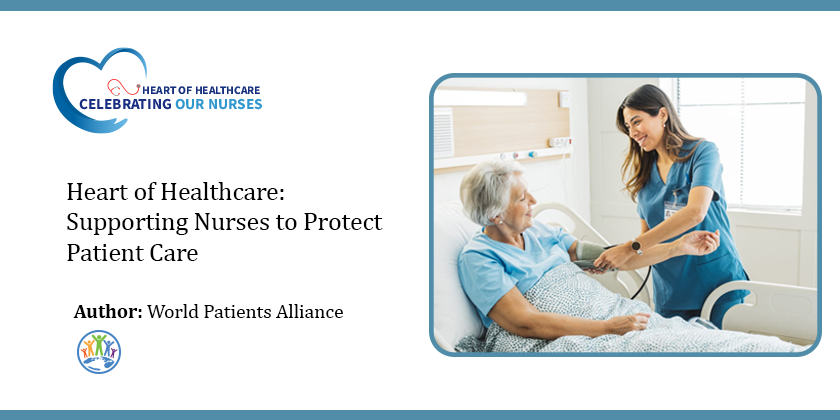
Heart of Healthcare: Celebrating Our Nurses is a campaign by the World Patients Alliance that recognises the vital role nurses play in patient care while also drawing attention to the pressures affecting the nursing workforce worldwide. The campaign aims to recognise the contribution of nurses while advocating for better working conditions, stronger mental health and well-being support, and better nurse retention.
From a patient point of view, these are not just workforce issues in the background. When nurse staffing runs short, care changes. Waiting times grow. Handover becomes tighter. Teaching and reassurance get squeezed. Small changes in a patient’s condition are easier to miss. Nurses are often the people who spot early decline, explain treatment, manage fear, and hold care together across the day. When there are too few nurses, patients feel the gap quickly.

There is a severe global shortage of nurses. WHO estimates that the world could face a shortfall of 4.5 million nurses by 2030, with the deepest gaps in Africa, South-East Asia, and the Eastern Mediterranean. WHO’s 2025 State of the World’s Nursing report also makes clear that the issue is not only the number of nurses available, but also where they are located, the conditions in which they work, and whether health systems are able to retain them in practice.

The International Council of Nurses’ 2025 survey of national nursing associations puts that strain into plain terms. Nearly two-thirds of respondents said pressure on the nursing workforce had risen since 2021, with more nurses leaving the sector, only 47.6% said their country had policies that give nurses access to workplace mental health support. About seven in ten said there were no policies to ensure adequate staffing levels. And 64.2% said staffing shortages were making it harder to maintain a safe environment for patient care. These are not isolated staffing problems. They point to a deeper failure in how systems retain, support, and protect nurses.

The well-being side of this crisis is just as serious. In WHO Europe’s 2025 survey, Mental Health of Nurses and Doctors in the European Union, Iceland and Norway, one in three doctors and nurses reported depression or anxiety, and more than one in ten reported passive suicidal thoughts. A 2024 JAMA Network Open meta-analysis, Nurse Burnout and Patient Safety, Satisfaction, and Quality of Care, which reviewed 85 studies involving 288,581 nurses, linked burnout with lower patient safety and quality of care, more infections, falls, medication errors, and adverse events, as well as lower patient satisfaction. Burnout is not a private weakness to manage quietly. It is a work and policy issue, and patients live with the consequences when systems ignore it.

Retention sits at the centre of all this, when experienced nurses leave, health systems do not just lose numbers. They lose judgment, continuity, mentoring, and local knowledge. New staff lose support. Teams become thinner. Patients face more risk. A 2025 JAMA Network Open study, Nurse Practice Environment, Job Satisfaction, and Turnover and Patient Falls, involving 8,584 hospital units, found that higher nurse turnover was associated with more patient falls, and that better job satisfaction and practice environments may help reduce turnover and improve safety outcomes. Nurse retention is not separate from the quality of care. It is fundamental to patient safety.
This is why the public debate on nursing must change. Health systems need safe staffing levels that are real, monitored, and clearly linked to patient safety. Nurses need working conditions that allow them to do their jobs well, without carrying unsafe workloads day after day. They need mental health and well-being support that is accessible, confidential, and available throughout the year, not only in moments of crisis. They also need real reasons to stay in the profession, including fair pay, support in the early years of practice, opportunities to grow, and leadership that treats nurse safety as part of care quality.

For the World Patients Alliance, that is the purpose of Heart of Healthcare: Celebrating Our Nurses. The campaign is not only about gratitude. It is about drawing attention to a simple but urgent truth: there is no patient safety without nurse well-being. We call on policymakers, regulators, nursing associations, and healthcare leaders to act on that reality. Recognition still matters, and nurses deserve to be seen, heard, and valued. But recognition without action leaves nurses under the same pressure and patients exposed to the same risks. If health systems want safer care, they must ensure that nurses are safe, supported, and able to stay in the profession.