

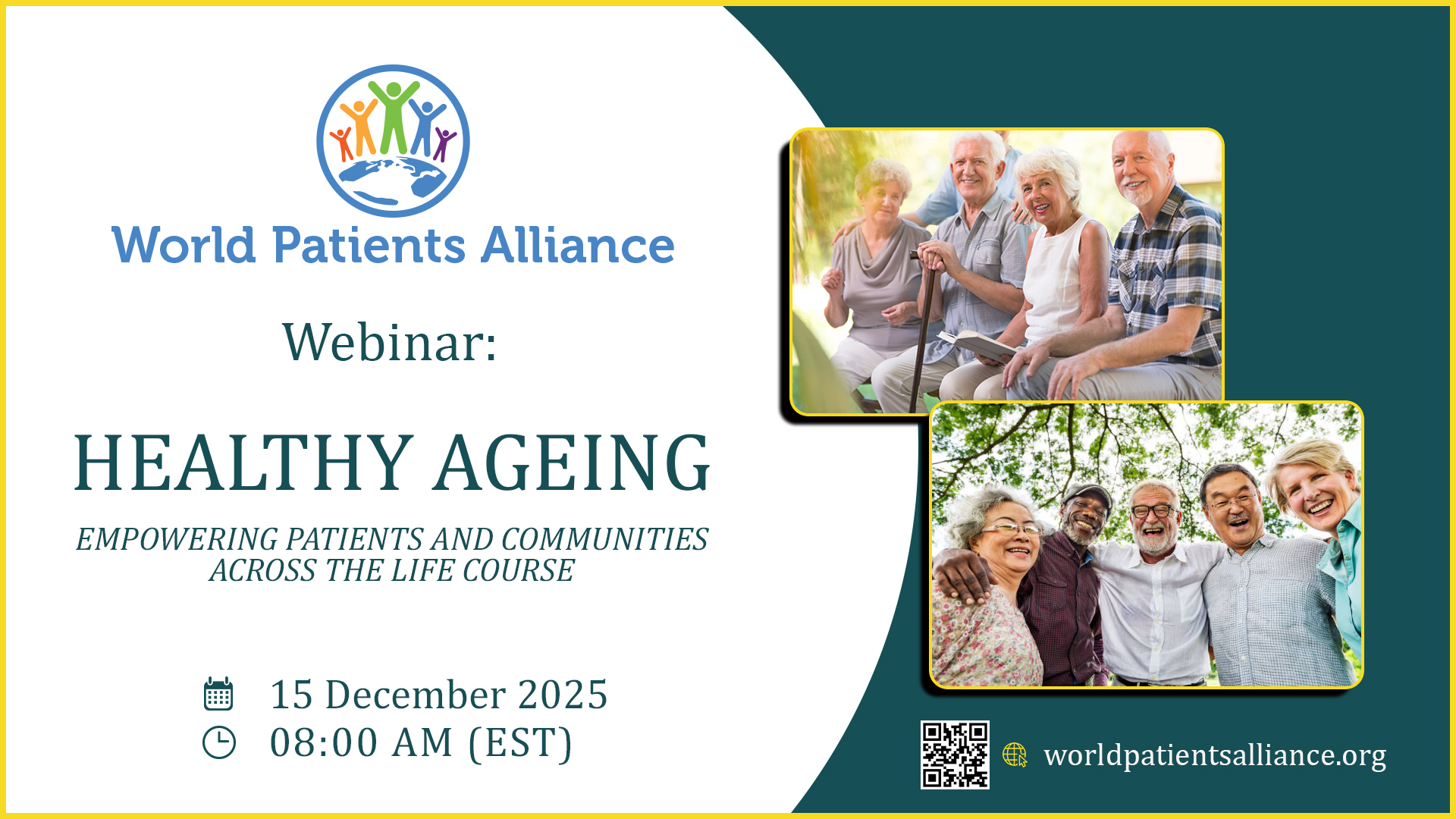
Webinar On Healthy Ageing
Date: December 15, 2025
Organized by: World Patients Alliance (WPA)
Overview
As populations age worldwide, the priority is not only living longer but living healthier. The session brought together experts and patient representatives o discuss global trends, challenges, and opportunities of ageing; share strategies to support wellbeing across the life course; and explore how community and patient contributions can build inclusive, age‑friendly, and resilient health systems.
Key Objectives of the Webinar
- -Enhance global preparedness for population ageing through evidence, based policy action.
- -Promote integrated, person, centred health, care models that maintain functional ability in older adults.
- -Strengthen supportive physical and social environments that enable healthy ageing.
- -Address core ageing, related challenges, including long, term care needs, pension sustainability, labour, market shifts, old, age poverty, and ageism.
- -Leverage opportunities for healthy ageing through stronger health systems, community, based care, and intersectoral collaboration.
- -Encourage individual behaviour change across the life course, such as healthy nutrition, activity, social connection, and self, care, to improve well, being in older age.
Speakers, Panelists, and Moderators
Welcome and Opening Remarks
Andrew Spiegel | Chair, Board of Directors | WPA
Understanding Ageing: Global Trends, Challenges, and Opportunities
Dr. Asghar Zaidi | Associate Professorial Fellow | Oxford University
The Decade of Healthy Ageing: Building Health Systems that Work for All Ages
Dr. Matteo Cesari | Scientist, Geriatrics and Gerontology | WHO
Panel Discussion
Moderator:
Hussain Jafri | CEO | WPA
Panelists:
Penney Cowan | Secretary | WPA
Katrina Bouzanis, Director, Policy and Advocacy | International Federation on Ageing
Dr. Matteo Cesari, Scientist Geriatrics and Gerontology | WHO
Dr. Asghar Zaidi | Associate Professorial Fellow | Oxford University
Welcome and Opening Remarks
Andrew Spiegel, Chair of the WPA Board of Directors, welcomed participants to the Healthy Ageing webinar and reiterated WPA’s commitment to ensuring patients are at the center of healthcare policy, planning, provision, and monitoring. He highlighted the Wordly multi‑language broadcast available in more than 50 languages to make the session accessible to participants whose first language is not English.
Andrew and Hussain Jafri (CEO, WPA) introduced the webinar’s aim: to understand why healthy ageing matters and how patients and communities can play a central role in achieving it. They outlined the agenda two plenary presentations followed by a panel discussion and Q&A.
Key Presentation
1. Understanding Ageing: Global Trends, Challenges, and Opportunities
Dr. Zaidi emphasized that population ageing is driven by longer lifespans, lower fertility, and global improvements in health and living conditions is reshaping societies worldwide. As the share of people aged 65+ and especially 80+ grows, countries face challenges such as rising long, term care needs, pension pressures, labour supply constraints, higher old age poverty risks, and pervasive ageism. These shifts are particularly difficult for lower income countries that are ageing before becoming wealthy. Yet ageing also presents opportunities: with strong public policies and healthy behaviours such as eating minimally processed foods, appropriate fasting, regular moderate exercise, mental engagement, and maintaining supportive social ties individuals and societies can promote healthier, more productive later life.
2. The Decade of Healthy Ageing: Building Health Systems that Work for All Ages
Dr. Cesari highlights the ongoing challenges posed by fragmented care systems, where older adults often navigate disjointed services offered through multiple specialists, distant clinics, or poorly integrated social and healthcare structures. These gaps are further compounded by ageist attitudes and limited interventions aimed at preserving intrinsic capacity. He stresses that to address these issues, health systems must move away from disease, specific approaches and adopt integrated, person cantered care models, allowing older adults to receive coordinated support closer to home. This shift is reinforced by WHO’s long, term care framework, which guides countries in building seamless and continuous care pathways.
Panel Discussion
Dr. Zaidi emphasized that population aging should never be framed as a problem but rather as a challenge that comes with societal success people live longer and healthier lives. He stressed that aging only becomes a problem when policies fail to adapt. He also noted that healthy aging requires addressing inequalities accumulated across the life course, especially for women who historically lacked pension access due to unpaid domestic roles.
Dr. Cesari discussed practical steps for countries to overcome fragmented health and social care systems. He highlighted the importance of conducting country, specific situation analyses, mapping available resources, task shifting to community health workers, and training both formal and informal caregivers. He also explained how the WHO’s ICOP approach focuses on evaluating capacity areas such as mobility, cognition, and nutrition essential for elder health especially in low, resource settings
Katrina discussed that aging is interconnected with economics, health, and social well, being. She emphasized the need for cross, sector collaboration to drive the UN Decade of Healthy Ageing forward. She highlighted Singapore’s integrated care system and the WHO Age, Friendly Cities Network as strong examples of healthy, aging models that can be adapted for other countries. She also noted that rapidly aging developing countries have a unique opportunity to design prevention, focused, community, based systems from the start.
Penny shared a personal perspective on aging, noting gaps in policy and health systems for older adults. She stressed the importance of nutrition, family support, physical activity, and sleep for maintaining health. She highlighted the need for open communication with healthcare providers to manage changing nutritional needs and emphasized that strong support networks can greatly improve quality of life as people age.
Q&A
Participants from multiple regions engaged via multilingual tools and Q&A. Questions covered integrated care, financing and pensions, cultural inclusivity, community‑based care, and practical healthy ageing tips (nutrition, sleep, activity, social support).
Key Takeaways
Global Ageing Trends
Population ageing is driven by longer lifespans, lower fertility, and better health conditions, it promotes healthy behaviours (balanced diet, moderate exercise, mental engagement, social ties) as well as strong public policies for active ageing
Health Systems for Healthy Ageing
Current systems are fragmented, forcing older adults to navigate multiple specialists and poorly integrated services. WHO’s long term care framework supports building seamless care pathways
Practical Healthy Ageing Tips
Eat minimally processed foods while practicing appropriate fasting. Engaging in regular moderate exercise &maintaining mental stimulation and social connections.
Closing Remarks
Hussain Jafri closed the session by thanking speakers and participants, emphasizing that ageing is accelerating worldwide and requires sustained attention. WPA will continue convening discussions, trainings, and initiatives on healthy ageing, and invites participants to stay connected and share questions by email.
This webinar provided a practical, people‑centred roadmap for healthy ageing: understand demographic realities, combat ageism, build age‑friendly environments, reorient care toward capacities, and enable integrated, community‑based services across the life course. With sustained collaboration and inclusive practices, patient organizations can help make healthy ageing achievable for everyone.