

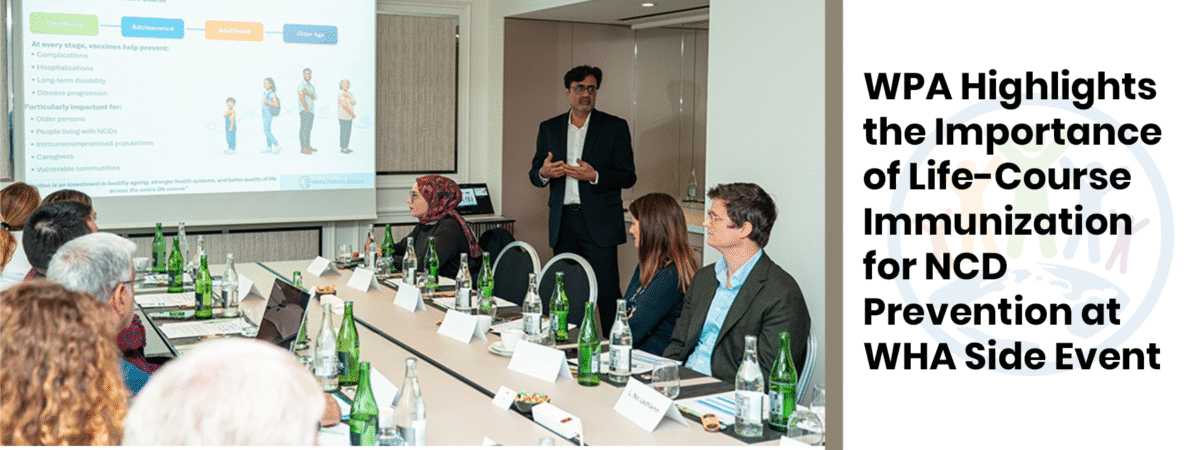
The WPA, represented by its CEO Hussain Jafri, participated in a high-level World Health Assembly side event on “Life-Course Immunization and the Prevention of Noncommunicable Diseases (NCDs)” held at the Mandarin Oriental Geneva. The event was organized by the World Federation of Public Health Associations (WFPHA) and brought together global health leaders, WHO representatives, patient organizations, technical experts, and policymakers to discuss the critical role of immunization in preventing noncommunicable diseases across the life course.
During the session, Hussain Jafri delivered a presentation titled “Patients’ Perspective: Why Life-Course Immunization is Key to Prevent Noncommunicable Diseases (NCDs)”, emphasizing that vaccination is not only about preventing infectious diseases, but also about preventing suffering, disability, avoidable complications, and protecting quality of life.
In his remarks, he highlighted the importance of adopting a life-course approach to immunization, stressing that vaccines continue to play a vital role from childhood through older age, particularly for people living with chronic diseases, older persons, immunocompromised individuals, caregivers, and vulnerable populations.
The WPA presentation also drew attention to the strong connection between immunization and NCD prevention. Examples discussed included HPV vaccination preventing cervical and other cancers, Hepatitis B vaccination reducing liver cancer risk, and influenza vaccination helping lower cardiovascular complications.
A key focus of the presentation was the barriers patients continue to face in accessing adult immunization, including misinformation, affordability challenges, weak adult immunization systems, and inequities in access. WPA stressed that adult immunization remains fragmented across many health systems and requires stronger integration into primary healthcare and NCD services.
Highlighting the importance of patient engagement, Hussain Jafri emphasized that patients must be partners, not passive recipients in immunization efforts. He underlined the critical role patient organizations play in building vaccine confidence, improving community trust, addressing misinformation, and shaping policy priorities.
WPA also called for:
– stronger integration of immunization into NCD strategies,
– expansion of adult vaccination programmes,
– equitable access to vaccines across the life course,
– investment in vaccine confidence and education,
– and meaningful involvement of patient organizations in policymaking.
The side event featured contributions from WHO, the Office of Health Economics, and country representatives from Italy, China, and Brazil, focusing on evidence linking life-course vaccination to reduced NCD burden and opportunities for policy action.
Closing his presentation, Hussain Jafri stated:
“Life-course immunization is not only a public health investment, it is an investment in people, dignity, and healthier lives.”
Through its participation, WPA reaffirmed its commitment to ensuring that patient voices remain central in global discussions on immunization, prevention, healthy ageing, and noncommunicable diseases.