

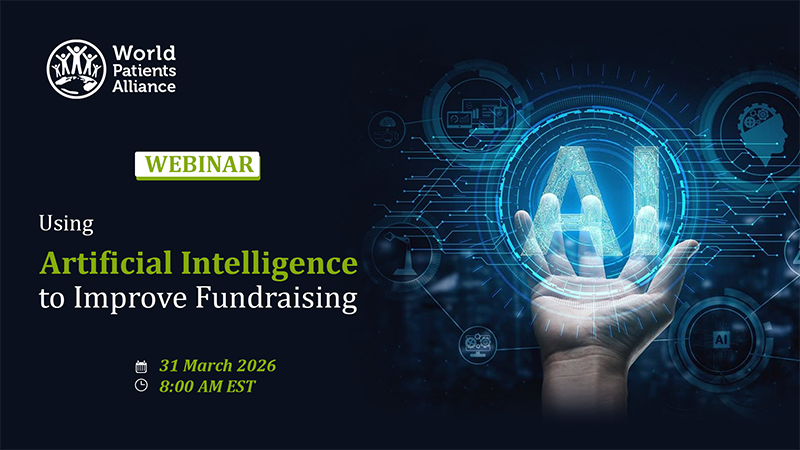
Webinar: Using Artificial Intelligence to Improve Fundraising
Webinar Report
Overview
The World Patients Alliance (WPA) hosted a webinar on using artificial intelligence to improve fundraising in patient organizations. The session focused on practical applications of AI across corporate partnerships, grants, and donor campaigns, demonstrating how AI can enhance performance analysis, identify funding opportunities, and strengthen proposals. It also highlighted the importance of human relationships, data privacy, and adopting simple, cost-effective AI solutions to improve efficiency
Key Objectives of the Webinar
– To provide practical guidance on using AI in fundraising
– To help organizations identify new funding opportunities using AI tools
– To improve the quality and effectiveness of grant proposals
– To strengthen donor engagement and communication strategies
– To enable more data-driven fundraising decisions
– To show how AI can increase efficiency and save time
– To reduce costs by using accessible and low-cost AI tools
– To support organizations of all sizes in adopting AI easily
– To promote diversification of funding sources
– To ultimately improve financial sustainability and patient outcomes
Welcome and Opening Remarks
Andrew Spiegel | Chair, Board of Directors | WPA
Speaker
- AI for Individual Donor Fundraising
2. AI for Institutional Funding and Grant Applications
Ravi Ruparel, Director Platform Worldwide
Welcome and Opening Remarks
Andrew Spiegel opened the webinar by warmly welcoming Speaker/ participants to the World Patients Alliance and highlighting the importance of the topic using AI to improve fundraising. He introduced the session as a response to strong member interest identified in WPA’s annual survey, where both AI and fundraising emerged as key learning priorities. Andrew also encouraged attendees to explore Ravi’s earlier three part webinar series on AI and fundraising available on the WPA YouTube channel. He concluded by introducing the speaker, Ravi Ruparel, emphasizing his expertise and significant fundraising achievements, before handing over the session to him.
Key Presentation
1- AI for Individual Donor Fundraising
Ravi Ruparel: Explained that AI can significantly improve individual donor fundraising by helping organizations better understand and manage their donor base. He said that AI can analyze past donation data to identify key patterns, such as who the most loyal donors are, who gives repeatedly, and who has stopped contributing. Based on this, organizations can use AI to develop strategies to retain active donors, re-engage inactive ones, and personalize their communication to increase donations.
He also emphasized that individual donors including patients, caregivers, and community members are an important but often underutilized funding source, and organizations should not hesitate to engage them. Additionally, AI can help identify what kind of stories or messages resonate most with donors, making outreach more effective. Ravi highlighted that using AI in this way can lead to measurable improvements, citing an example where fundraising increased significantly when AI was applied strategically.
2- AI for Institutional Funding and Grant Applications
Ravi Ruparel: Ravi explained that AI can greatly enhance institutional funding and grant applications by improving both the quality of proposals and the efficiency of the process.
He said that organizations can use AI to analyse past grant applications, including those that were unsuccessful, to understand what worked and what didn’t. By uploading previous proposals into AI tools, organizations can identify gaps, improve structure, and strengthen future applications. AI can also help discover new grant opportunities more quickly by scanning large amounts of information and identifying relevant funding sources.
Ravi highlighted that writing grant proposals becomes much faster with AI. By combining a previous application with a new funding call, AI can generate a refined and tailored proposal within seconds. However, he emphasized that human review is essential, as relationships, context, and final quality checks must be handled by people.
He also introduced AI-powered platforms that support grant discovery and proposal writing, noting that although some tools may have a cost, they can be highly valuable if they help secure funding. For those with limited budgets, he demonstrated that similar solutions can even be created using low-cost or no-code tools.
Ravi emphasized that AI allows organizations to work smarter, apply more strategically, save time, and increase their chances of securing institutional funding, while still maintaining human oversight and relationship-building.
Q&A
Participants engaged in an interactive discussion focusing on the practical application of AI in fundraising. The conversation highlighted key areas such as the selection of suitable AI tools, with ChatGPT and Claude recommended as accessible starting points, and encouraged users to explore different platforms based on their needs. Concerns around data privacy and security were addressed, emphasizing that responsibility lies with users to avoid sharing sensitive information, use anonymized data, and ensure secure settings. The discussion also covered cost and accessibility, noting that many AI tools offer low-cost or free options, making them suitable for organizations with limited resources. Additionally, participants raised questions about the environmental impact of AI, with recommendations to understand actual usage implications and adopt responsible practices. Overall, the session underscored the importance of starting with simple use cases, learning through hands-on interaction, and gradually integrating AI into fundraising workflows to enhance efficiency and effectiveness.
Closing Remarks
Dr. Hussain Jafri expressed appreciation to Ravi Ruparel for delivering an insightful and practical session on using artificial intelligence in fundraising. He highlighted that the webinar directly addressed the needs identified by WPA members, particularly in strengthening fundraising capacity and understanding emerging tools like AI.
Dr. Jafri emphasized that AI is not a complex or distant concept but a practical and accessible solution that can help organizations improve efficiency, identify funding opportunities, and develop stronger proposals, even with limited resources. He encouraged participants to start with simple applications of the ideas shared and gradually integrate AI into their work.
He also reaffirmed WPA’s commitment to supporting patient organizations globally through knowledge-sharing, training, and capacity-building initiatives. The session concluded with thanks to all participants for their engagement and continued dedication to improving patient outcomes worldwide.
Agenda
Welcome and Opening Remarks
Andrew Spiegel, Chair World Patients Alliance
1. AI for Individual Donor Fundraising
2. AI for Institutional Funding and Grant Applications
Ravi Ruparel, Director Platform Worldwide
Closing Remarks
Hussain Jafri, CEO World Patients Alliance