- (000) 123 458 789
- office@worldpatientsalliance.org


ESSENTIAL TESTS FOR DIABETES AND PREDIABETES
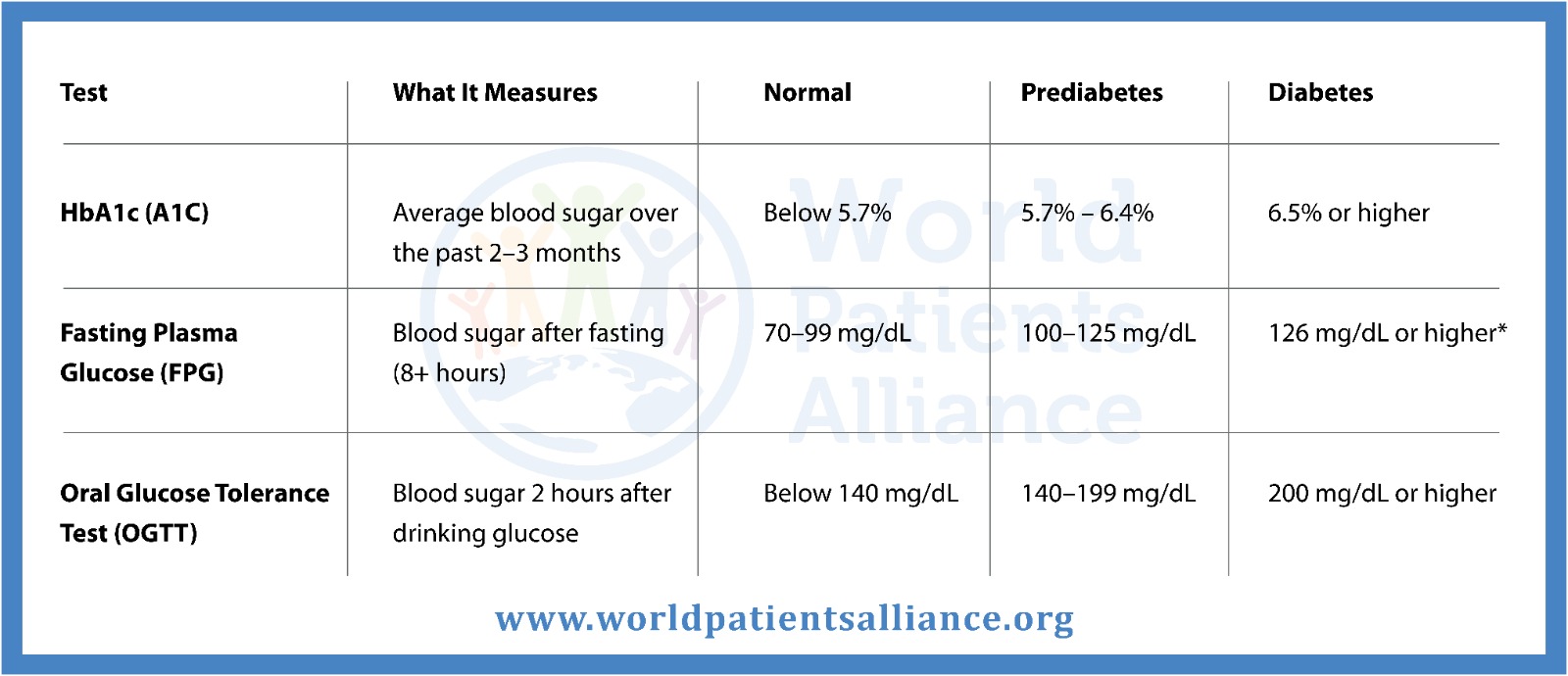
There are three main tests used to check for prediabetes and diabetes. These tests measure how much sugar (glucose) is in your blood and how well your body is managing it.
The only way to confirm prediabetes or diabetes is through a blood test.
1. HbA1c TEST
The HbA1c test measures your average blood sugar levels over the past 2–3 months. The result is given as a percentage.
Healthcare providers use this test to:
– Detect prediabetes
– Help diagnose type 2 diabetes
– Monitor blood sugar control over time
What do the results mean?
– Normal: Below 5.7%
Blood sugar levels are within the healthy range.
– Prediabetes: 5.7%–6.4%
Blood sugar levels are higher than normal, indicating increased risk.
– Diabetes: 6.5% or higher
Suggests diabetes, usually confirmed with repeat testing.
2. FASTING PLASMA GLUCOSE (FPG) TEST
This test measures blood sugar after fasting for at least 8 hours.
It helps assess how well your body controls blood sugar.
What do the results mean?
– Normal: 70–99 mg/dL
Healthy blood sugar levels.
– Prediabetes: 100–125 mg/dL
Blood sugar is higher than normal.
– Diabetes: 126 mg/dL or higher on two separate tests
Suggests diabetes.
3. ORAL GLUCOSE TOLERANCE TEST (OGTT)
This test shows how well your body handles sugar.
How the test works:
– A fasting blood sample is taken
– You drink a glucose solution
– Blood sugar is measured again after 2 hours
What do the results mean?
– Normal: Less than 140 mg/dL
Blood sugar returns to the normal range.
– Prediabetes: 140–199 mg/dL
Blood sugar is higher than normal.
– Diabetes: 200 mg/dL or higher
Suggests diabetes.
Important note
A single test result is not always enough to confirm a diagnosis. Your healthcare provider may repeat the test or use additional tests to make a final diagnosis.