

28 September 2026
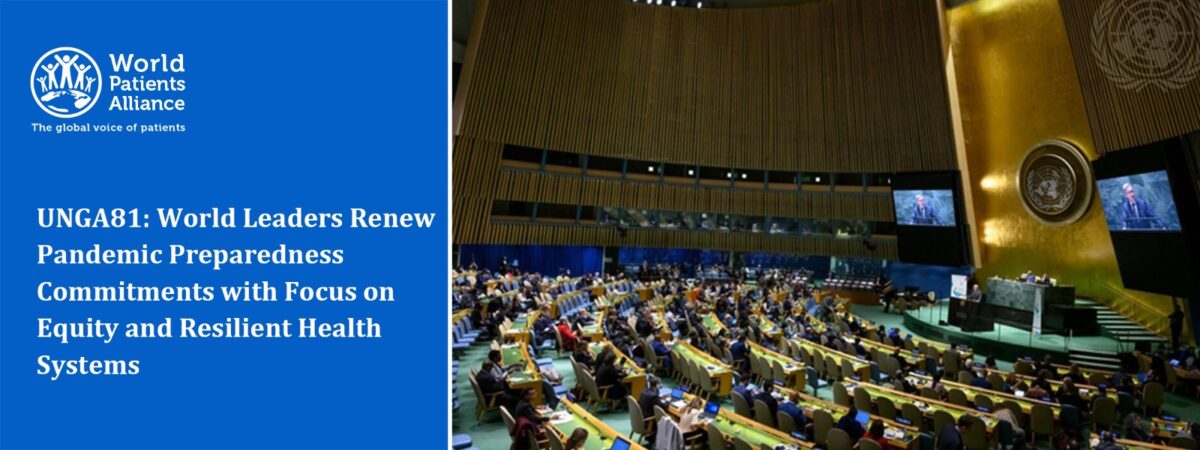
The World Patients Alliance (WPA) welcomes the renewed global attention to pandemic prevention, preparedness and response at the Second United Nations General Assembly High-Level Meeting on Pandemic Prevention, Preparedness and Response, held on 25 September 2026 at the United Nations Headquarters in New York.
World leaders and health ministers came together to review progress since the first UN High-Level Meeting on pandemic preparedness in 2023 and to strengthen international cooperation to better protect people and communities from future health emergencies. The meeting considered an action-oriented Political Declaration on Pandemic Prevention, Preparedness and Response, negotiated by Member States around the principles of equity, solidarity, international cooperation and sustainable investment.
The meeting took place six years after the emergence of COVID-19, which exposed major weaknesses in health systems and profound inequalities in access to vaccines, diagnostics, treatments and other essential health products. UN and WHO leaders stressed that the lessons of COVID-19 must translate into stronger preparedness before the next global health emergency occurs. UN News highlighted the need for stronger health systems, improved readiness and a more equitable international response to future pandemics.
Commitments that matter to patients
The Political Declaration includes commitments to strengthen local and national preparedness capacities, resilient health systems, trust in public health institutions, community engagement, and solidarity and equity in access to health products, tools and resources.
These commitments are particularly important from a patient perspective. Health emergencies affect far more than people infected by a new pathogen. During COVID-19, patients around the world experienced disruptions in routine treatment, diagnosis, medicines and essential health services. Building pandemic preparedness into strong, resilient and people-centred health systems is therefore essential not only for responding to emergencies but also for protecting continuity of care for all patients.
The President of the UN General Assembly, Dr Khalilur Rahman, emphasized that preparedness should be connected to the everyday work of building resilient, equitable and people-centred health systems, rather than treated as a temporary activity activated only during crises.
For WPA, the strong emphasis on community engagement is also significant. Patients, families, caregivers and patient organizations bring practical knowledge of how health policies and emergency measures affect people in their daily lives. Their meaningful involvement can help health authorities understand community needs, strengthen trust, improve communication and design responses that are accessible and responsive to the people they are intended to serve.
Equity in access remains a global priority
One of the clearest lessons of COVID-19 was the unequal access to vaccines, diagnostics, treatments and other essential medical products between and within countries.
The new declaration places equity and solidarity at the centre of pandemic preparedness and calls for continued efforts to expand equitable access to the products, tools and resources needed during health emergencies. WHO Director-General Dr Tedros Adhanom Ghebreyesus described the commitments as addressing important gaps through stronger national capacities, resilient health systems and more equitable access.
The declaration also recognizes that pandemic prevention begins well before an emergency and highlights a One Health approach, acknowledging the close connections between human, animal and environmental health.
Next step: completing the Pandemic Agreement
A major issue highlighted during the meeting was the need to complete negotiations on the Pathogen Access and Benefit-Sharing (PABS) system, an annex to the WHO Pandemic Agreement.
The WHO Pandemic Agreement was adopted by Member States in 2025, representing a major development in international cooperation on pandemic preparedness. The remaining PABS negotiations are intended to establish arrangements for the timely sharing of pathogens with pandemic potential while also ensuring benefits arising from their use, including vaccines, medicines and diagnostics, are shared more equitably.
WHO states that adoption of the PABS annex at the World Health Assembly in May 2027 will be necessary before Member States can move forward with national consideration of ratification of the Pandemic Agreement.
From political commitments to action for patients
The World Patients Alliance believes that the real measure of pandemic preparedness will ultimately be how global commitments translate into improvements for people and communities.
For patients, this means health systems capable of maintaining essential services during emergencies; timely and affordable access to vaccines, diagnostics, medicines and other health technologies; clear and trusted health information; and meaningful opportunities for patients and communities to contribute to preparedness planning and decision-making.
WPA will continue to follow the implementation of these global commitments and advocate for patients and communities to be meaningfully engaged in the development, implementation and evaluation of pandemic preparedness policies at national, regional and global levels.
The experience of COVID-19 demonstrated that effective pandemic preparedness is not only about responding rapidly to a new pathogen. It is also about building health systems that are equitable, resilient, trusted and centred on the needs of people.