

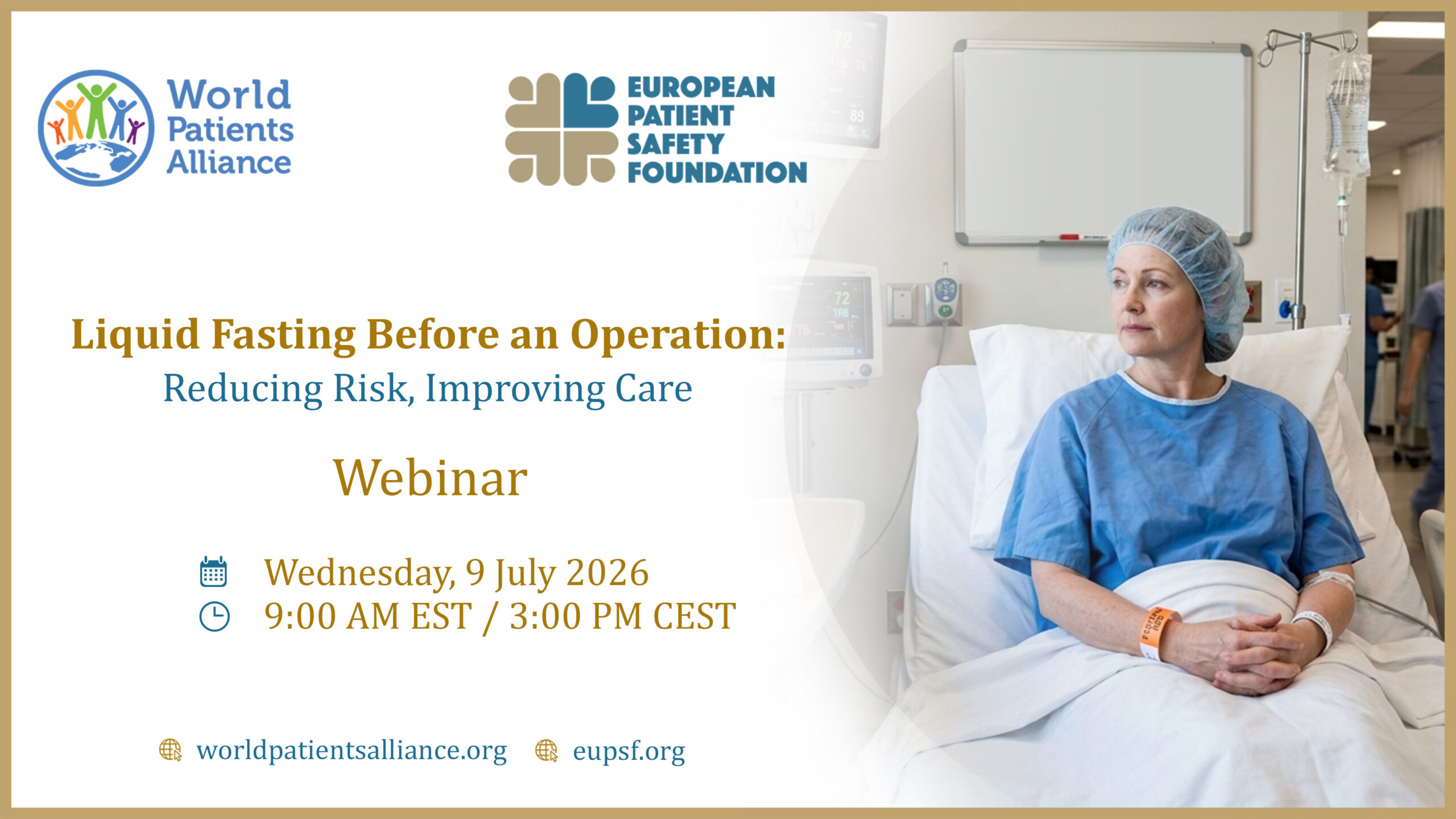
Liquid Fasting Before an Operation: Reducing Risk, Improving Care
Date: 9 July 2026
Organized by: World Patients Alliance (WPA) and European Patient Safety Foundation (EUPSF)
Overview
The webinar of Liquid Fasting Before an Operation: Reducing Risk, Improving Care brought together anesthesiologists, patient safety leaders, nurses, family physicians, patient advocates, and healthcare professionals to examine current evidence on pre-operative liquid fasting practices.
This session highlighted the gap between existing fasting guidelines and real world implementation, emphasizing that prolonged fasting before surgery remains common worldwide despite evidence supporting clear liquid intake up to two hours before anesthesia.
Key Objectives of the Webinar
– Raise awareness of the impact of prolonged pre-operative liquid fasting on patient safety.
– Promote evidence based fasting practices that reduce unnecessary dehydration.
– Highlight international consensus recommendations on perioperative fasting.
– Strengthen understanding of the relationship between fasting, patient outcomes, and healthcare quality.
– Encourage multidisciplinary collaboration among patients, clinicians, nurses, and healthcare organizations.
– Support advocacy efforts aimed at improving implementation of modern fasting protocols.
Agenda
Welcome and Introductions
Andrew Spiegel | Chair, Board of Directors | WPA
Key Presentation
From ‘Nothing After Midnight’ to Evidence-Based Care: The New International Consensus on Pre-operative Liquid Fasting
Dr. Anne Rüggeberg (Germany) | Anaesthesiologist and Lead of the Fasting Card Project
Patient Perspective: Real-World Examples from Different Regions
Helen Haskell, Chair | WPA Patient Safety & Quality Council
Patient Perspective: Real-World Examples from Different Regions
Helen Haskell, Chair, WPA Patient Safety & Quality Council
Panel Discussion
Moderator
Haskell, Chair, WPA Patient Safety & Quality Council
Panelists
– Dr. Anne Marie Camilleri Podesta | Consultant in Anaesthesia and Intensive Care, Malta
– Doina Carmen Mazilu | EUPSF Board Member and Vice-President of the Order of Nurses, Midwives and Medical Assistants in Romania
– Prof. María Pilar Astier Peña | President Elect | World Organization of Family Doctors (WONCA)
– Jolanta Bilinska | Founding Board Director, WPA
– Dr. Anne Rüggeberg | Anaesthesiologist and Consensus Statement Lead
Closing Remarks
Mirka Cikkelova | General Secretary| EUPSF
Welcome and Opening Remarks
Andrew Spiegel welcomed participants from around the world and highlighted the importance of discussing perioperative fasting, a topic that affects nearly every patient undergoing surgery. He introduced the World Patients Alliance and reiterated WPA’s commitment to patient-centred healthcare, patient engagement, and global collaboration.
Key Presentation
From “Nothing After Midnight” to Evidence-Based Care: The New International Consensus on Pre-operative Liquid Fasting
Dr. Anne Rüggeberg
Dr. Anne Rüggeberg presented evidence demonstrating that prolonged liquid fasting remains common despite more than two decades of guidelines permitting clear liquids up to two hours before anesthesia. She explained that many patients continue to fast for 9–14 hours before surgery, resulting in unnecessary dehydration and associated complications. She highlighted research showing links between prolonged fasting and increased risks of delirium, cardiovascular complications, renal dysfunction, respiratory complications, and poorer patient experiences.
Dr. Rüggeberg reviewed the historical origins of fasting practices, explaining how concerns about aspiration led to the widespread adoption of “nothing after midnight” policies. However, she emphasized that contemporary evidence demonstrates clear liquids empty rapidly from the stomach and do not significantly increase aspiration risk when consumed before surgery. She noted that aspiration events are rare and are more commonly linked to underlying clinical risk factors than to clear liquid consumption.
She also presented findings from the 2026 International Multidisciplinary Consensus Statement on Perioperative Fasting, developed through systematic review and a global Delphi process involving multidisciplinary stakeholders. The statement supports minimizing prolonged fasting, continuing modern recommendations for clear liquid intake, and allowing institutions to adopt more flexible, patient-centred fasting protocols.
A key innovation highlighted was the Fasting Card system, a color-coded approach that enables individualized fasting management. Dr. Rüggeberg shared results demonstrating that implementation of fasting cards reduced median fasting times from approximately twelve hours to just over two hours while improving patient hydration and medication adherence. The model has since been adopted by more than 150 hospitals in Germany and has received major patient safety awards.
Improving Patient Safety Through Evidence Based Fasting Practices
Helen Haskell
She emphasized that although medical guidelines allow patients to drink clear liquids up to two hours before surgery, many hospitals still require patients to fast from midnight, resulting in unnecessarily long fasting periods.
She shared personal experiences involving her son and sister-in-law, illustrating how prolonged fasting and dehydration can contribute to serious complications. These stories highlighted the importance of proper hydration before surgery and the need for patient-centered care.
Helen also presented the findings of a survey conducted among World Patients Alliance board and council members from different WHO regions. The survey showed that most patients were instructed not to eat or drink for much longer than recommended, with many experiencing excessive thirst, hunger, discomfort, anxiety, and delayed recovery due to prolonged fasting.
She stressed that delays in surgery often extend fasting times further, increasing the risk of dehydration and other complications. Helen called for better communication between healthcare professionals and patients, greater awareness of current evidence based fasting guidelines, and stronger implementation of practices that prioritize patient safety, comfort, and dignity.
Panel Discussion
The panel discussion explored the practical, clinical, and patient-centred implications of modernizing fasting practices and implementing evidence-based approaches across healthcare systems.
Jolanta Bilinska: shared a personal experience involving her elderly mother, whose surgery was repeatedly delayed, resulting in prolonged fasting and significant distress. She emphasized the need for better communication, education, and patient empowerment to ensure patients understand and can advocate for safe fasting practices.
Dr. Anne Marie Camilleri Podesta: highlighted the substantial implementation gap between fasting guidelines and actual clinical practice. She noted that while institutions often document compliance with the two-hour rule, actual fasting durations are rarely measured and frequently extend far beyond recommendations. She stressed the need for multidisciplinary education and system-wide solutions.
Doina Carmen Mazilu: discussed the nursing perspective, noting that nurses routinely witness the effects of prolonged fasting, including anxiety, thirst, confusion, and discomfort. She emphasized the importance of evidence-based protocols, communication tools, and nursing education to support compassionate, patient-centred care.
Prof. María Pilar Astier Peña: provided a primary care perspective, emphasizing continuity of care and the importance of coordinated messaging among family doctors, anesthesiologists, surgeons, and patients. She highlighted the risks prolonged fasting poses to older adults and people with chronic conditions and advocated for better integration of fasting guidance across the patient journey.
Dr. Anne Rüggeberg: addressed audience questions regarding implementation strategies, low-resource settings, patient advocacy, aspiration risk, hydration, and fasting protocols. She reinforced that clear liquids are safe for most patients, inexpensive, and often preferable to intravenous hydration alone. She encouraged healthcare professionals and patients alike to promote awareness and challenge outdated fasting practices.
Q&A
During the Q&A session, participants asked several important questions regarding the implementation of evidence based preoperative fasting guidelines. The discussion covered patient safety, healthcare practices, and strategies for improving fasting protocols worldwide.
The panel explained that although international guidelines recommend allowing patients to drink clear liquids up to two hours before surgery, many hospitals still follow the outdated “nothing after midnight" rule. Experts highlighted that this implementation gap often leads to prolonged fasting, dehydration, increased patient discomfort, and a higher risk of complications such as delirium and kidney injury.
Questions were raised about the WHO Safe Surgery Checklist and whether fasting practices are adequately monitored. The speakers noted that while hospitals often check whether patients have fasted for at least two hours, they rarely record excessively long fasting times, allowing the problem to go unnoticed.
The panel also discussed fasting recommendations for patients with chronic illnesses such as diabetes, autoimmune diseases, and those taking medications that require individualized management. They emphasized that fasting instructions should be tailored according to each patient’s medical condition while maintaining adequate hydration whenever possible.
Another topic was how low resource healthcare settings can improve patient care. The experts explained that allowing patients to drink clear liquids is a simple, low cost intervention that reduces dehydration without increasing the risk of aspiration during elective surgery.
Patient advocates and healthcare professionals shared real life experiences showing how delayed surgeries often result in unnecessarily prolonged fasting. The panel stressed the importance of educating patients, nurses, surgeons, anesthesiologists, and family physicians about current evidence-based guidelines. They also encouraged hospitals to adopt practical initiatives such as color coded fasting cards and standardized communication to ensure patients receive consistent instructions.
The session concluded with a call for stronger collaboration among healthcare professionals and patient organizations to promote evidence based fasting practices, improve patient comfort, reduce complications, and enhance overall patient safety.
Key Takeaways
– Prolonged pre-operative liquid fasting remains common despite modern guidelines.
– Excessive fasting can contribute to dehydration, delirium, kidney injury, and patient discomfort.
– Clear liquid consumption before surgery does not appear to increase aspiration risk in most patients.
– Evidence-based fasting protocols can improve hydration, safety, and patient experience.
– Multidisciplinary collaboration is essential to close the implementation gap.
– Patient education and empowerment play a critical role in driving safer perioperative care.
Closing Remarks
Mirka Cikkelova concluded the webinar by emphasizing that prolonged liquid fasting is an overlooked patient safety issue that deserves greater visibility and action. She noted that while important progress has been made in generating evidence, the next challenge is improving implementation across healthcare systems. She encouraged ongoing collaboration among patients, healthcare professionals, researchers, and policy leaders to ensure safer, evidence-based perioperative care. The European Patient Safety Foundation reaffirmed its commitment to continuing this dialogue and supporting practical change that benefits patients worldwide.



Excellent panelists discussing fasting duration and patient safety throughout the pre-, intra-, and post-operative periods. This is a very important topic! As a pediatrician, emergency physician, and pediatric surgeon, I congratulate you for organizing this event with professionals who have such extensive experience in the field!