
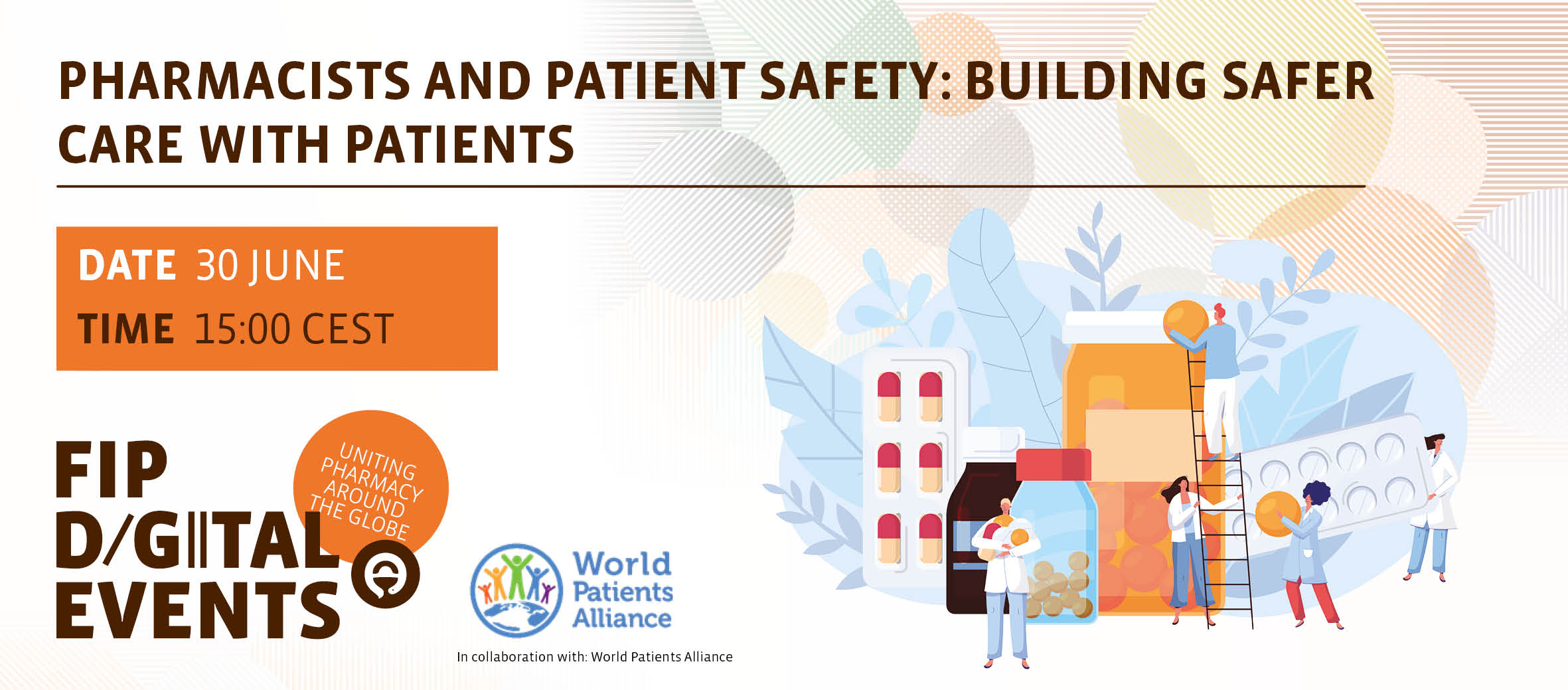
Pharmacists and Patient Safety: Building safer care with Patients
Webinar Report
Date: June 30, 2026
Organized by: International Pharmaceutical Federation (FIP) in collaboration with the World Patients Alliance (WPA)
Overview
The WPA in collaboration with the International Pharmaceutical Federation (FIP), hosted a global webinar titled “Pharmacists and Patient Safety: Building Safer Care with Patients” on June 30, 2026.
The webinar brought together pharmacists, patient advocates, healthcare professionals, educators, and patient safety experts to examine the expanding role of pharmacists in preventing medication-related harm and improving patient outcomes.
The webinar highlighted how pharmacists can contribute to safer care through medication management, early identification of health risks, patient education, disease prevention, and collaboration with patients, families, and other healthcare professionals.
The discussion placed particular emphasis on the importance of treating patients as active partners in medication safety. Speakers demonstrated that safer medication use depends not only on professional expertise and effective health systems, but also on open communication, patient empowerment, shared decision-making, and mutual trust.
Key Objectives of the Webinar
– Explore the role of pharmacists across healthcare settings in advancing medication and patient safety.
– Demonstrate the impact of pharmacist-led interventions on reducing medication-related harm and improving clinical outcomes.
– Highlight the importance of patient empowerment, health literacy, and shared decision-making.
– Strengthen teamwork and communication among pharmacists, patients, families, and other healthcare professionals.
– Share practical examples of pharmacist-led medication reviews, preventive services, community engagement, and patient education.
– Discuss how digital technologies and artificial intelligence can support patient safety while maintaining human-centred care.
Welcome and Opening Remarks
Marianne F. Ivey welcomed participants on behalf of FIP and emphasized that pharmacists serve as an essential safety net within healthcare systems. She explained that pharmacists have a professional responsibility to prevent medication-related harm and ensure that patients receive medicines that are safe, appropriate, and effective.
She also introduced FIP’s work on patient safety, including its Development Goal 19 on patient safety, professional education and training resources, global medication safety initiatives, and the FIP policy statement on the role of pharmacists in promoting patient safety.
Helen Haskell welcomed participants on behalf of WPA and shared her perspective as a patient advocate, caregiver, and parent. Drawing on more than 25 years of work in patient safety, she highlighted the widespread nature of medication-related harm and the importance of recognizing and learning from adverse medication events.
She stressed that pharmacists possess valuable knowledge that can help identify medication risks and prevent harm. She encouraged pharmacists to use their expertise more visibly and work directly with patients and families as partners in safer care.
Key Presentations
Advancing Patient Safety: The Expanding Role of Pharmacists Across Health Systems
John Hertig provided an overview of the global burden of medication-related harm and the role of pharmacists in strengthening medication safety systems.
He explained that medication safety covers the complete medication-use process, including prescribing, transcribing, dispensing, administering, and monitoring. Pharmacists must therefore look beyond the accurate supply of medicines and contribute to safety throughout the entire process.
A central message from his presentation was that the goal of medication safety should not simply be the elimination of errors. Since human error cannot always be completely prevented, healthcare systems must be designed to ensure that errors do not reach patients and result in harm.
He emphasized the importance of developing a strong safety culture built on:
– Open and non-punitive reporting of medication errors.
– Continuous learning and professional development.
– Effective communication across healthcare teams.
– Systems-based approaches to identifying and managing risks.
– Greater investment in patient safety research and implementation.
– Active involvement of patients in decisions concerning their care.
John also discussed the growing role of medication safety officers within hospitals and health systems. These professionals coordinate medication safety programmes, analyze reported incidents, improve organizational systems, support staff education, and promote a culture of learning.
He encouraged all pharmacists to see themselves as medication safety leaders, regardless of their official position or title. Pharmacists can make meaningful improvements by understanding their organization’s systems, identifying weaknesses, using available safety tools, and implementing incremental changes.
He concluded by reminding participants that pharmacists are essential to achieving the global goal of zero preventable harm and that every medication safety decision must place the patient first.
Improving Teamwork and Communication for Medication Safety and Patient-Centred Care
Regina Mariam Namata Kamoga presented the patient and community perspective, drawing attention to the medication safety challenges experienced in low- and middle-income countries.
She identified several factors contributing to unsafe medication use, including:
– Low levels of health literacy.
– Limited access to reliable medication information.
– Self-medication and medicine sharing.
– Use of unregulated or traditional remedies.
– Weak pharmacovigilance and regulatory systems.
– Inadequate communication between patients and healthcare professionals.
– Heavy workloads and limited time for patient counselling.
– Paternalistic healthcare cultures in which patients may feel unable to ask questions.
Regina emphasized that medication safety must be patient-centred because patients and families are often the first to recognize changes, side effects, or unexpected reactions. Minor symptoms can become serious when patients do not know what to look for, whom to contact, or how to report their concerns.
She called for respectful communication using open-ended questions and language that patients can understand. Healthcare professionals must create an environment in which patients feel comfortable discussing their concerns, experiences, cultural beliefs, and practical challenges.
Regina described the work of the Community Health and Information Network in Uganda, including health literacy initiatives, patient education, community mobilization, training for healthcare professionals and community health workers, and collaboration with regulatory authorities.
She highlighted the value of national systems that enable patients to report suspected medicine and vaccine side effects directly. Such systems help ensure that patient experiences become visible and contribute to national pharmacovigilance data.
She also shared an innovative approach involving children as patient safety ambassadors. Through stories, music, drama, sports, and educational materials, children can learn safe health behaviours and encourage safer medication practices within their families and communities.
Her presentation demonstrated that sustainable medication safety requires continuous community engagement rather than short-term interventions. Trust must be developed through long-term, respectful, and mutually beneficial partnerships.
From Intervention to Impact: Reducing Medication Errors Through Patient-Centred Care
Mohamed Elsabakhawi shared practical experiences from pharmacist-led primary care clinics in community pharmacy settings in Canada.
He described community pharmacies as accessible healthcare homes where pharmacists can provide medication reviews, point-of-care testing, immunization, chronic disease management, patient education, and timely referrals.
Through comprehensive medication reviews, pharmacists can identify common drug-related problems, including:
– Medicines that patients no longer need.
– Conditions for which patients require treatment but are not receiving it.
– Doses that are too high or too low.
– Drug interactions.
– Side effects and adverse reactions.
– Incorrect administration or timing of medicines.
– Non-adherence and misunderstanding of treatment.
– Medication discrepancies following hospital discharge.
Mohamed shared several patient examples demonstrating the value of asking additional questions and “digging deeper.” In one case, a patient seeking a sleeping medicine was experiencing disrupted sleep because a diuretic was being taken at night rather than in the morning. Changing the timing of the existing medicine prevented the unnecessary addition of another medication.
In another example, a patient appeared to be regularly collecting diabetes medication but had stopped taking it because of depression. A detailed conversation allowed the pharmacist to identify the underlying problem and refer the patient for appropriate medical care.
He also discussed the contribution of point-of-care testing to early detection. By testing indicators such as blood glucose, HbA1c, and cholesterol, pharmacists can identify patients at risk of diabetes or cardiovascular disease, provide education, make referrals, and arrange follow-up before serious complications occur.
Mohamed explained that immunization is another important part of preventive care. Many patients remain unvaccinated not because they actively refuse vaccines, but because no healthcare professional has discussed the available options with them.
He concluded that patient safety in community pharmacy extends far beyond dispensing accuracy. It involves identifying risks, educating and empowering patients, documenting therapeutic concerns, communicating with other healthcare providers, and following up with patients over time.
Panel Discussion and Q&A
The panel discussion explored practical changes needed for pharmacists to be fully recognized as patient safety leaders.
Speakers agreed that pharmacists must be involved throughout the complete medication-use process rather than being viewed only as medicine dispensers. Greater awareness is required among patients, pharmacists, other healthcare professionals, educational institutions, and health system leaders about the broader patient safety contribution of pharmacy.
The discussion identified trust as one of the profession’s greatest strengths. Community pharmacists frequently interact with patients and often develop long-term relationships with them. These relationships provide opportunities to identify misunderstandings, detect emerging health concerns, support adherence, and encourage patients to speak openly about medication-related problems.
The panellists discussed why patients may hesitate to raise concerns. Barriers include limited knowledge, fear of appearing uninformed, cultural expectations, and unequal relationships between patients and healthcare professionals.
Healthcare professionals were encouraged to reduce the perceived authority gap by inviting questions, listening without judgement, and making it clear that patients are valued members of the healthcare team.
Patients should receive clear information about:
– The purpose of each medicine.
– How and when it should be taken.
– Expected benefits and when they may occur.
– Possible side effects and warning signs.
– What to do if a dose is missed.
– Where and how to report concerns.
– When to return to a pharmacist or contact another healthcare professional.
The panel emphasized that patients’ ability to understand and contribute to their care is often underestimated. Providing appropriate information can significantly improve trust, confidence, and medication safety.
Participants discussed how digital health and artificial intelligence could support medication safety.
The panellists recognized that AI can help pharmacists access information, analyze data, identify risks, improve workflow, and support clinical decisions. Pharmacists who use AI responsibly may be better equipped to provide efficient and informed care.
However, speakers agreed that technology should not replace professional judgement, personal communication, or the relationship between pharmacists and patients. Human oversight remains essential, particularly when interpreting individual circumstances, understanding patient preferences, and making clinical decisions.
They emphasized that the key issue is not whether pharmacists should use AI, but how it should be used responsibly, safely, and transparently.
The discussion also addressed fragmented healthcare systems, limited access to pharmacists, health literacy gaps, traditional medicine use, and weak reporting mechanisms.
Regina recommended developing structured community engagement and empowerment strategies that involve patient organizations, community pharmacists, healthcare workers, religious leaders, cultural leaders, local authorities, and other trusted community representatives.
Speakers encouraged a shift from top-down interventions towards collaborative approaches that recognize patients’ lived experiences and community knowledge.
Medication safety and error-reporting principles should also be incorporated early into pharmacy education. Students should learn that errors must be reported and examined as opportunities for improving systems rather than hidden because of fear or blame.
Key Takeaways and Recommendations
Recognize Pharmacists as Patient Safety Leaders
Pharmacists should be empowered to lead medication safety programmes across community, hospital, primary care, academic, regulatory, and public health settings.
Their contribution should extend throughout the medication-use process, from procurement and prescribing support to dispensing, administration, monitoring, patient education, and pharmacovigilance.
Strengthen Patient Education and Health Literacy
Patients need clear, accessible, and culturally appropriate information about their medicines.
Pharmacists should regularly explain treatment goals, administration instructions, side effects, warning signs, interactions, and reporting options. Communication should be adapted for people with different literacy levels and linguistic or cultural backgrounds.
Build Trusting and Respectful Relationships
Trust is essential for patients to disclose medication problems, non-adherence, side effects, traditional medicine use, or concerns about treatment.
Pharmacists and other healthcare professionals should use open-ended questions, listen carefully, avoid judgement, and actively invite patients and families to participate in decisions.
Develop Strong Reporting and Learning Systems
Healthcare organizations should establish accessible, non-punitive systems for reporting medication errors and adverse events.
Patient-reported concerns should be recognized as valuable safety data and incorporated into pharmacovigilance, quality improvement, and policy development.
Improve Communication Across Transitions of Care
Medication-related harm frequently occurs when patients move between hospitals, primary care, community pharmacies, and home.
Clear medication reconciliation, discharge counselling, communication among healthcare providers, and follow-up with patients are necessary to prevent omissions, duplication, interactions, and misunderstandings.
Expand Pharmacist-Led Preventive Services
Medication reviews, chronic disease management, immunization, point-of-care testing, and patient follow-up can help identify risks before they result in harm.
Health systems should enable pharmacists to provide these services within an appropriate scope of practice and in coordination with other healthcare professionals.
Embed Medication Safety in Pharmacy Education
Medication safety, patient engagement, communication, human factors, systems thinking, error reporting, and leadership should be integrated throughout pharmacy education and continuing professional development.
Maintain Human Oversight of Digital Technologies
Artificial intelligence and digital health tools can support medication safety, but they must be used responsibly.
Professional judgement, accountability, transparency, patient consent, data protection, and personal communication must remain central to technology-supported care.
Engage Communities Through Long-Term Partnerships
Medication safety initiatives must be developed with communities rather than delivered only to them.
Patient organizations, community advocates, local leaders, pharmacists, regulators, and healthcare professionals should work together through sustained and respectful partnerships.
Closing Remarks
In her closing remarks, Marianne F. Ivey summarized the webinar’s central message: pharmacists are expected to serve as leaders in patient safety and should actively step into that responsibility.
She reflected on John Hertig’s systems-based foundation for medication safety, Regina Kamoga’s emphasis on community engagement and communication, and Mohamed Elsabakhawi’s practical examples of pharmacist-led preventive care.
She reinforced that safer medication use requires effective communication among patients, pharmacists, prescribers, nurses, caregivers, and all other members of the healthcare team. Listening carefully to patients and taking their concerns seriously are fundamental components of safe and person-centred care.
The webinar concluded with a shared call for pharmacists, patient organizations, healthcare professionals, educators, and policymakers to work together to strengthen medication safety systems.
FIP and WPA remain committed to advancing patient-centred medication safety, supporting professional leadership, promoting health literacy, and ensuring that patients and families are recognized as essential partners in safer care.