

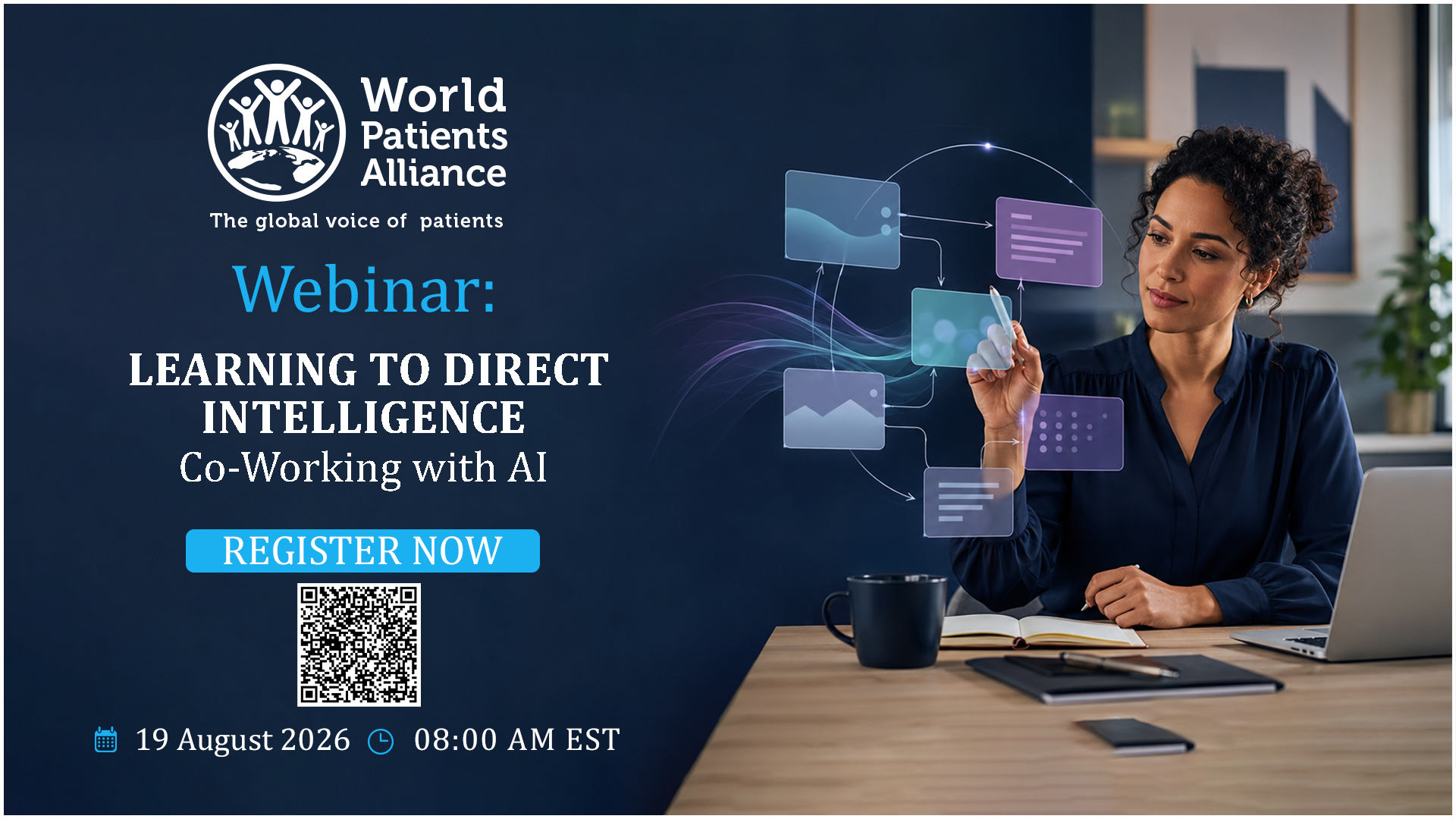
Learning to Direct Intelligence: Co-Working with AI
Organized by: WPA and Platform Worldwide
Overview
The webinar Learning to Direct Intelligence: Co-Working with AI brought together patient advocates, leaders of patient organizations, healthcare stakeholders, and technology experts to explore the evolving role of artificial intelligence (AI) in supporting advocacy, communications, research, and organizational effectiveness.
The session examined how patient organizations can move beyond basic AI use and adopt a more strategic approach to working alongside AI systems. Discussions focused on practical applications of AI, the concept of “co-working” with AI, the importance of maintaining human oversight, data privacy considerations, and methods for improving productivity while preserving accountability and patient-centred values.
Key Objectives of the Webinar
– Increase understanding of how AI can support patient organizations and advocacy efforts.
– Introduce the concept of co-working with AI rather than using AI solely as a chat or search tool.
– Demonstrate practical applications of AI for communications, research, fundraising, and project management.
– Promote responsible AI use through strong governance, privacy, and ethical considerations.
– Encourage participants to explore AI tools that enhance organizational capacity and efficiency.
– Strengthen confidence in using AI while maintaining human judgement and accountability.
AGENDA
Welcome and opening remarks
Andrew Spiegel | Founding Board Member | WPA
Key Presentation
Learning to Direct Intelligence: Co-Working with AI
Ravi Ruparel| Patient Advocate and Founder | Platform Worldwide
Question-and-answer session
Key Takeaways
Closing Remarks
Dr. Hussain Jafri | CEO| World Patients Alliance
Welcome and Opening Remarks
Andrew Spiegel welcomed participants from around the world and encouraged attendees to engage actively throughout the webinar. He highlighted the growing importance of artificial intelligence in daily life and emphasized WPA’s commitment to helping patient organizations understand and leverage emerging technologies responsibly. He also introduced the World Patients Alliance, outlined its global reach, and encouraged participants to remain engaged through future webinars and the upcoming World Patients Conference in Nairobi, Kenya.
Key Presentation
Learning to Direct Intelligence: Co-Working with AI
Ravi Ruparel
Ravi introduced the concept of “learning to direct intelligence,” explaining that many people currently use AI primarily as a conversational tool or replacement for traditional search engines. He noted that while adoption of AI has grown rapidly, many users remain in what he described as a “consumer” stage, relying on AI for isolated tasks without fully understanding its broader capabilities.
He emphasized the importance of transitioning from being a passive consumer of AI to becoming an active operator who directs AI systems with purpose, context, and long-term objectives. According to Ravi, effective AI use requires users to provide clear instructions, maintain oversight, establish project specific memory, and guide AI outputs so they remain aligned with organizational goals and values.
A major focus of the presentation was the concept of “co-working” with AI. Ravi explained that modern AI platforms increasingly support project-based environments where organizations can store institutional knowledge, governance documents, branding materials, and guidance that AI can consistently reference across multiple tasks. This approach reduces repetitive work while improving consistency and efficiency.
He also highlighted the diverse forms of intelligence that AI can simulate, including research, writing, editing, data analysis, design, communications, fundraising, and strategic planning. Participants were encouraged to think of AI as a collaborative assistant capable of supporting multiple professional functions while remaining under human direction.
Practical Demonstration: AI-Powered Project Development:
To illustrate the potential of co-working with AI, Ravi presented a practical demonstration involving a hypothetical patient organization. The example explored how AI could be used to develop a funding proposal advocating for the replacement of printed patient information booklets with QR code keychains that provide digital access to educational resources.
Using project memory, organizational branding, supporting materials, and a simple written brief, Ravi demonstrated how AI could create a professional fundraising presentation. He explained that AI was able to combine research, cost calculations, communications strategy, and visual design into a polished proposal with minimal manual effort. The demonstration highlighted how patient organizations can accelerate project development while maintaining oversight of all outputs.
Ravi stressed that the value of AI lies not merely in automation but in enabling organizations to devote more time to strategic thinking, advocacy, and relationship building.
Responsible and Effective AI Use:
The presentation also addressed responsible AI implementation. Ravi emphasized the importance of protecting confidential information, ensuring compliance with privacy regulations, obtaining appropriate consent, and maintaining transparency regarding the role of AI in content development.
He encouraged organizations to establish AI governance policies and consider how AI fits into existing workflows. While AI can significantly enhance productivity, he noted that human review remains essential, particularly in healthcare and patient advocacy contexts where accuracy, ethics, and trust are paramount.
Q&A
During the Q&A session, participants raised questions about AI implementation strategies, cost considerations, organizational readiness, project management, and long-term governance.
Several questions focused on the differences between free and paid AI services. The discussion highlighted that more advanced co-working capabilities are often associated with premium versions, although discounted pricing may be available for nonprofit organizations.
Participants also sought advice on conducting research with AI, particularly for projects involving healthcare systems and patient advocacy. Ravi recommended approaching AI as a collaborative coach that can help users clarify objectives, structure projects, identify audiences, and refine outputs throughout the development process.
Additional questions explored best practices for project management, storage of organizational knowledge, transparency about AI use, and methods for maintaining high-quality outputs. The discussion emphasized ongoing experimentation, continuous learning, and the importance of balancing innovation with appropriate safeguards.
The session concluded with reflections on the future role of AI in healthcare, patient engagement, and advocacy. Participants agreed that while AI presents significant opportunities, its successful integration will depend on strong governance, transparency, human oversight, and a continued focus on patient needs.
Key Takeaways
– AI can serve as a powerful partner for patient organizations when used strategically and responsibly.
– Moving from passive AI use to active AI direction can significantly enhance productivity and project outcomes.
– Project based co-working environments provide continuity, memory, and greater organizational efficiency.
– Human judgement, ethical oversight, and accountability remain essential when using AI.
– Data privacy, confidentiality, and governance should remain central to all AI activities.
– Patient organizations can leverage AI to strengthen communications, research, fundraising, and advocacy efforts.
– Ongoing experimentation and learning are key to unlocking AI’s full potential while maintaining trust and transparency.
Closing Remarks
Dr. Hussain Jafri CEO of World Patients Alliance thanked Ravi for delivering an insightful and practical session and emphasized that technology should ultimately serve people and improve patient outcomes. He reflected on the opportunities AI presents for patient organizations and advocacy teams to enhance research, communications, and organizational effectiveness. Dr. Jafri also reminded participants of WPA’s upcoming World Patient Safety Day webinar and the 3rd World Patients Conference in Nairobi, Kenya, encouraging continued engagement and collaboration across the global patient community.