

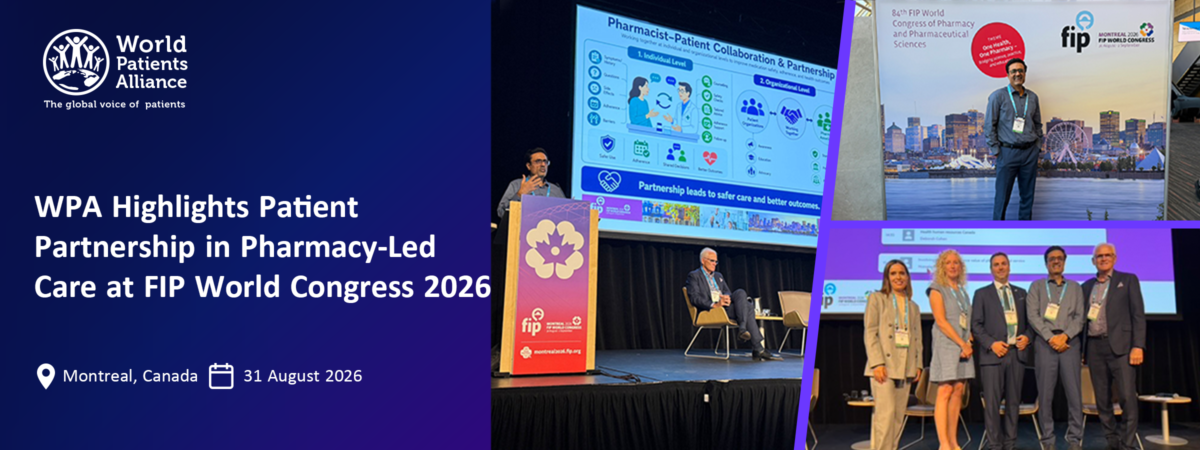
Montreal, Canada, 31 August 2026 | The World Patients Alliance (WPA) contributed to an important discussion on equitable access to pharmacy-led care at the 84th FIP World Congress of Pharmacy and Pharmaceutical Sciences in Montreal, Canada.
Prof. Hussain Jafri, CEO representing the World Patients Alliance, spoke during the session “Connecting the regulatory dots: Cross-system partnership to equitable access to pharmacy-led care.” His presentation, titled “Involving patients to enhance value of pharmaceutical service,” highlighted the importance of placing patients at the centre of pharmaceutical care, service design and health system collaboration.
The session brought together perspectives from pharmacy regulators, workforce experts, community pharmacy leaders and patient advocates. It focused on how collaboration among regulators, governments, professionals, patients and communities can help build more inclusive, sustainable and equitable health systems, particularly for rural, underpopulated and underserved communities.
In his remarks, Prof. Jafri emphasized that pharmaceutical services create the greatest value when they are designed and delivered with patients, not only for patients. While pharmacists bring essential expertise in medicines, patients and caregivers bring lived experience of illness, treatment burden, access barriers, affordability concerns and daily medicine use.
He noted that, from a patient perspective, value is not limited to receiving the correct medicine. True value is created when patients can access medicines and services, understand their treatment, use medicines safely, feel respected, and receive the support they need to manage their health in daily life.
The presentation also highlighted the role of patients and caregivers in improving medicine safety, adherence, communication and trust. Patient involvement can help identify barriers that may otherwise remain invisible to health professionals and policymakers, including low health literacy, medicine affordability, disability, stigma, distance from services, language barriers, digital exclusion and lack of caregiver support.
Prof. Jafri stressed that pharmacists are among the most accessible health professionals in many communities and are therefore well placed to support people-centered care. However, to maximize the value of pharmacy-led services, pharmacists must be supported to listen to patients, communicate in plain language, involve caregivers where appropriate, and work closely with patient organisations.
A key message from the WPA perspective was that patient involvement should not be tokenistic. Patients should be engaged early in the design, delivery and evaluation of pharmaceutical services, as well as in the development of policies, standards and regulatory frameworks that affect access to care.
The presentation aligned closely with the FIP Development Goals on Working with Others, Equity and Equality, and Access to Medicines, Devices and Services. It reinforced the need for stronger partnerships between pharmacists, regulators, policymakers, patient organisations and communities to ensure that pharmacy-led care is accessible, trusted, equitable and meaningful.
WPA believes that patients are not only recipients of pharmaceutical services; they are partners in creating their value. By involving patients and caregivers, health systems can move beyond medicine availability towards real access, safe use, better understanding and improved outcomes.
The session concluded with a panel discussion on how cross-system collaboration can strengthen health equity and expand access to quality pharmacy-led care across different settings.
WPA will continue to advocate for the meaningful involvement of patients in all areas of healthcare policy, regulation, service design and delivery, including pharmaceutical care. The future of pharmacy-led care must be built not only around medicines, but around the people who use them.