

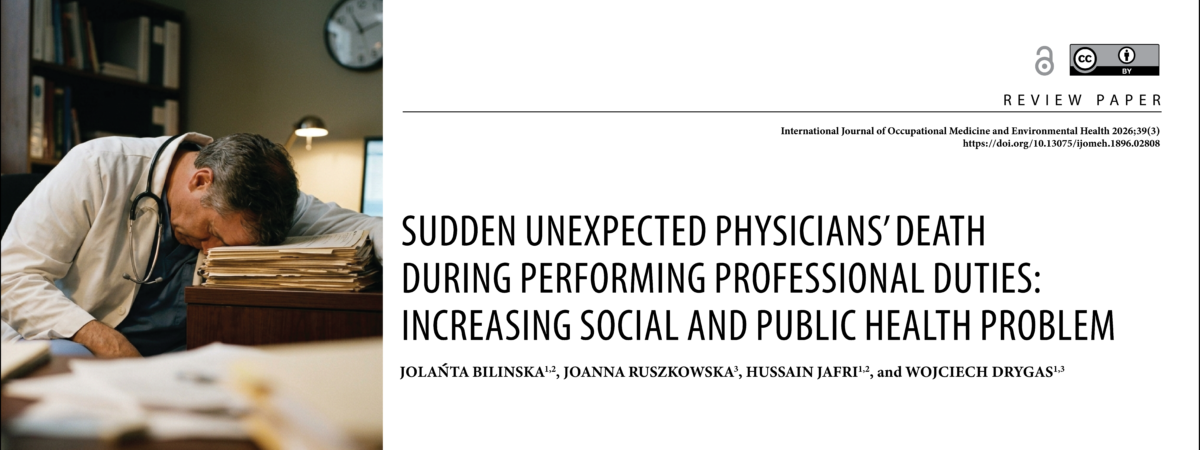
A new review paper authored by researchers from the World Patients Alliance, the University of Kalisz, and the Medical University of Lodz has drawn attention to the growing and insufficiently recognized problem of sudden unexpected deaths among physicians while performing their professional duties.
The paper, titled “Sudden Unexpected Physicians’ Death During Performing Professional Duties: Increasing Social and Public Health Problem,” has been published in the International Journal of Occupational Medicine and Environmental Health. The authors are Jolanta Bilińska, Joanna Ruszkowska, Hussain Jafri, and Wojciech Drygas.
Why this matters to patients
The sudden death of a physician is first and foremost a profound human tragedy for the physician’s family, colleagues, and community. It also has serious consequences for the patients who depend on that physician for care.
When a doctor dies unexpectedly, patients may lose a trusted healthcare professional who understands their medical history, treatment preferences, and personal circumstances. This can disrupt continuity of care, delay treatment, increase waiting times, and place additional pressure on already overstretched healthcare teams.
The loss of experienced physicians is particularly damaging in health systems facing workforce shortages. Remaining doctors may be required to work longer hours and manage greater numbers of patients, increasing the risk of exhaustion, burnout, communication failures, and medication or diagnostic errors.
The paper emphasizes that an exhausted doctor may face risks to their own health while also being less able to provide consistently safe and effective care. Protecting physicians must therefore be understood as an essential part of protecting patients and strengthening patient safety.
A neglected global problem
The review examined available evidence from different regions of the world and found that sudden physician deaths are reported across countries and healthcare systems. However, the problem remains poorly documented and insufficiently studied.
The causes identified include excessive workloads, prolonged working hours, burnout, suicide, underlying health problems, workplace violence, and inadequate institutional support. Physicians working in surgery, anaesthesiology, emergency medicine, intensive care, and psychiatry may face particularly high levels of risk because of the intensity and pressure associated with these specialties.
The authors also highlight the scarcity of systematic reporting. In many countries, cases become known only through media reports or informal accounts, making it difficult to understand the true scale of the problem and develop effective preventive measures.
Safe working conditions support safe patient care
Patients expect healthcare professionals to be competent, attentive, compassionate, and available when care is needed. These expectations can only be met when healthcare workers are themselves supported by safe and humane working conditions.
Reasonable working hours, adequate staffing, protected rest periods, psychological support, fair remuneration, protection from violence, and access to occupational health services are not simply workforce issues. They are fundamental requirements for the delivery of safe, continuous, and patient-centred care.
Healthcare organizations must also create environments in which physicians can seek help for physical or mental health concerns without fear of stigma, professional consequences, or damage to their careers.
A call for coordinated action
The paper calls for coordinated action by governments, healthcare organizations, medical societies, regulators, and other stakeholders. Recommended priorities include:
– stronger reporting and data systems;
– regulation of excessive working hours;
– improved staffing and working conditions;
– accessible mental health and psychological support;
– prevention of workplace violence;
– regular health screening and occupational support; and
– further research into physician deaths and their wider impact on health systems.
The World Patients Alliance believes that patients and patient organizations should also be included in these discussions. Patients have an important role in advocating for healthcare systems that protect both those who receive care and those who provide it.
Protecting healthcare professionals protects patients
Healthcare professionals are central to every patient’s experience of care. Their health, safety, and wellbeing directly influence the quality, continuity, and safety of healthcare services.
This publication reinforces a fundamental message: health systems cannot provide safe care to patients unless they also provide safe working conditions for healthcare professionals.
By bringing greater attention to sudden unexpected physician deaths, the authors hope to encourage stronger research, better policies, and practical action to protect physicians—and, in doing so, protect the patients and communities who rely on them.
Access the full article here: https://doi.org/10.13075/ijomeh.1896.02808